Showing posts with label Devised Theatre. Show all posts

Sunday, 12 January 2014

Introductory Sketches

The trail begins with my anxiety that my approach to devised theatre – as a critic – is based in the same concerns as my approach to scripted theatre. After wide reading, I stumbled upon a common theme in many devised process: a dialectic process informs their creation and development.

The following research trail examines fragments of my quest to find an interrogative instrument for devised theatre. There’s no conclusion, beyond a vague assertion that some but not all devised performances can be analysed in terms of a dialectic process.

One major case study of Joint Stock’s Fanshen and a smaller one for Gecko’s The Arab and The Jew provide examples of dialectic in devised work.

A brief survey of devised political work from the 1950s to the 1980s is conducted through studies of Heddon and Milling’s Devising Performance, Baz Kershaw’s The Politics of Performance and C. Carr’s On Edge, concentrating on evidence of dialectic in their construction, alongside Joan Littlewood’s Theatre Workshop and Lecoq's auto-cours teaching technique. 


A tentative suggestion is made that a dialectic process informs the development of devised theatre and is an important process within it. 

Saturday, 11 January 2014

Thesis: The Anarchic Theatre of the 1960s

The Living Theatre
In The New Radical Theatre Notebook, Arthur Sainer presents an eclectic and fragmented survey of the 1960s fringe theatre in the USA. From the Firehouse Theatre’s provocative audience interaction during Still Failing (‘I disrobed that young lady and she was very agreeable… she started doing a little dance number,’ remembers Marlow Hotchkiss (Sainer, 1975, p201) to The Living Theatre’s collective creation (when asked about a forthcoming production, founder Julian Beck replied ‘We haven’t created it yet. It’s going to be put together by the company the way Frankenstein was,’ cited Sainer 1975, p295), America radical theatre challenged both theatrical form and the society around it. 


In her description of performance art, RoseLee Goldberg reflects this definition: 'permissive, open-
Uncle Fatso
ended medium with endless variables, executed by artists impatient with the limitations of more established art forms' (cited in Carlson 1996 p79). This description easily describes the attitude of the companies discussed by Sainer, who lead political demonstrations (The Bread and Puppet Theatre had their giant puppet Uncle Fatso, a caricature of then-president Johnson), or encourage audiences to buck the system –San Francisco Mime Troupe’s Ronnie Davies’ ‘guerrilla theatre,’ included practical skits teaching passers-by ‘how to stuff the parking meter’ (cited Sainer, 1975 p 49) and  even helped Black Panther Eldridge Cleaver escape arrest.

Their legacy s is clear throughout C Carr’s essays on the art scene of America in the 1980s and 1990s (Carr, 1993). From the emerging cross-border experiments of Guillermo Gomez-Pena to the Kipper Kids unique slapstick vaudeville, Carr emphasises their rawness, echoing the brutality of the New York No Wave music scene, but also harking back to the earlier experiments. 
Lecoq
While the rage of the 1980s precludes much of the playful joy of the happenings of the 1960s - The Om-Theatre held a sharing service in a church which respected the environment and maintained a sense of fun (Sainer, 1997 p66 -73) - the outrage at political oppression and the insistence on the immediacy of expression is shared. The anarchic refusal to respect authority, and the ownership of the performance by the performers, echoes the pioneering mayhem of the guerrilla theatre.This fringe theatre had been inspired by the simultaneous social resistance of the 1960s – in France, the riots of 1968 inspired Jacque Lecoq to develop a distinctive aspect of his training. The auto-cours is time set aside for the students to teach each other.

‘(The students) said to Lecoq, we don't want to work, we want to teach ourselves' (McBirney, cited in Murray 2003, p61). Far from compromising with the demands, Lecoq found a way to integrate them into the curriculum. This self-taught work is then presented and as Murray notes (op cited p61) assessed with a high 'degree of formality... the student group subjected to a fair, but rigorously astringent, analysis from a team of tutors.'

Itself created as a result of the dialogue between student and teacher, the auto-cours also follows a dialectic model: the demands for independent learning and freedom, which follow similar experiments of American radical companies, are balanced against the discipline of academic assessment: Lecoq synthesised the apparently oppositional ideas.


Antithesis: British Leftist Theatre
Synthesis: Fanshen


Friday, 10 January 2014

Synthesis: Gecko's The Arab and The Jew (Case Study)

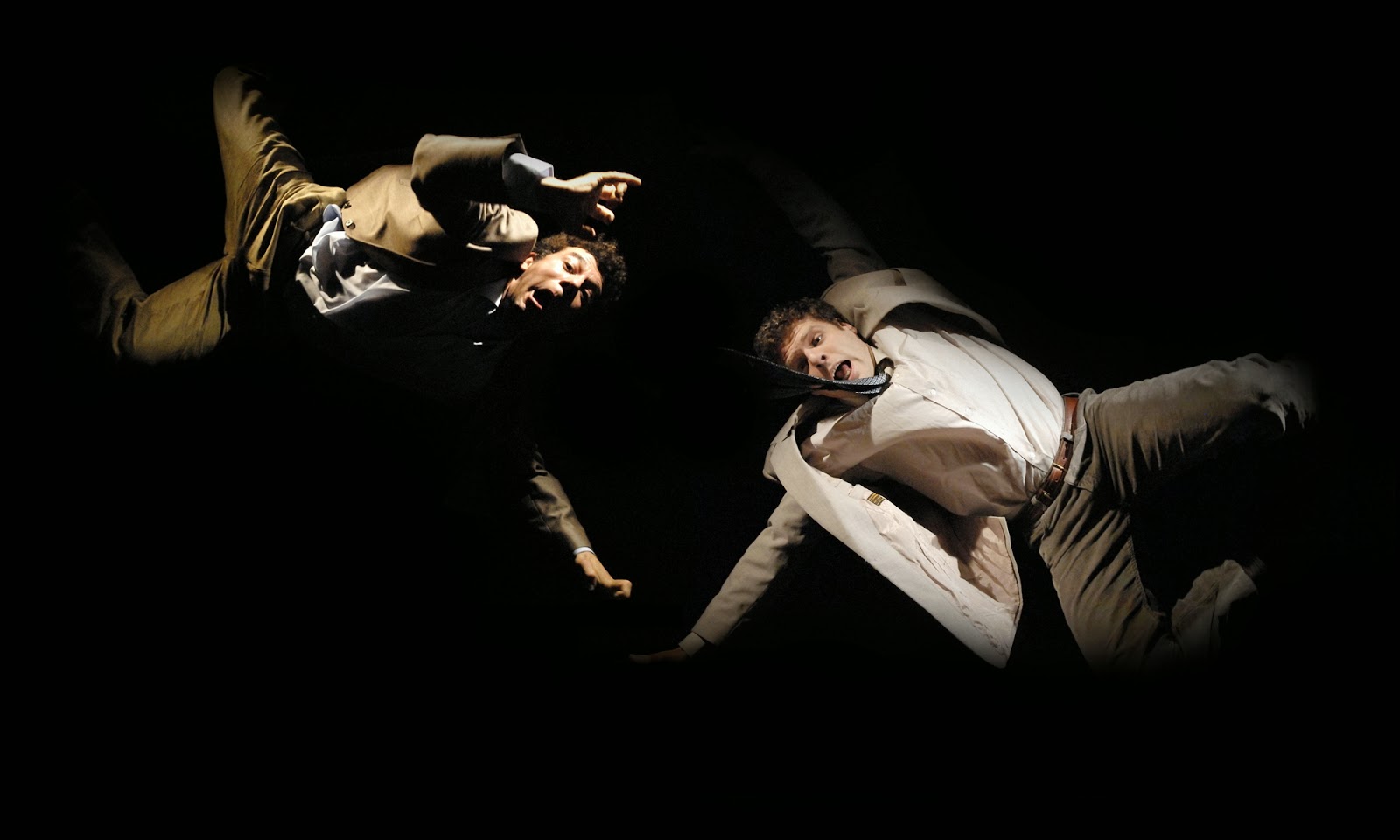
Arab and Jew
So ubiquitous is Lecoq’s influence, Jackie Smart’s Sculpting the Territory (ed. Memikides and Smart, 2010 p167) invokes him even though Gecko's relationship to the school is indirect - they have worked with David Glass and Steven Berkoff, who are both Lecoq trained. Smart notes that the genesis of The Arab and The Jew lies in the playful collaboration of Gecko's artistic directors Amit Lahav and Allel Nedjari, echoing Lecoq’s emphasis on le jeu at the centre of training.
The final production was considered in both political and personal contexts, but Gecko were insistent that ‘any individual interpretation is valid’ (op cited, p 182). The title might hint at a discussion of the Middle East, but the intentions were more personal.

Having a show about Arabs and Jews had had a long gestation period... they already felt that they were... moving more towards the subject of 'brotherhood.' They wanted, they said, to explore their theatrical relationship (op cited, p170).

Jackie Smart details their devising process, paying attention both to the increased political considerations (op cited p182) and the nature of their collaboration. She expresses surprise that 'going for coffee' was a key strategy to help them overcome blocks (op cited p173), and notes that
conversation, alongside the working out of a physical vocabulary, was at the centre of their preparations. The two men were engaging their very different cultural roots in a dialectic process that could find a shared expression on stage.

The particular process of Gecko - even in contemporary interviews, remaining director Lahav is eclectic when naming influences - moves between different stages in a manner that is dialectical. The casual 'going for coffee' is balanced against formal presentations of the show as a work in progress (versions appeared in Ipswich, Newbury, Cambridge and Bristol before reaching the Edinburgh British Council Showcase).
The conversation between Lahav and Nedjari is then introduced into a conversation with audiences: and, as Smart observes 'Gecko productions are in continual development' (op cited, p166) and 'reflection and renewal occur on a continuous basis throughout' (op cited p182).
Far from the agitprop of CAST or Fanshen’s script - Gecko are more likely to train in boxing than write text - the process of The Arab and The Jew still shares the central focus of an on-going dialogue within the company: the dialectic is now extended, through works in progress, to include the audience. The diffidence to the final interpretation of the company suggests that Baz Kershaw’s ‘irony’ allows contemporary devising companies to approach ‘a potentially dangerous emotional journey’ (op cited, p 172) and gain ‘confidence in being overtly political’ (op cited p182).